
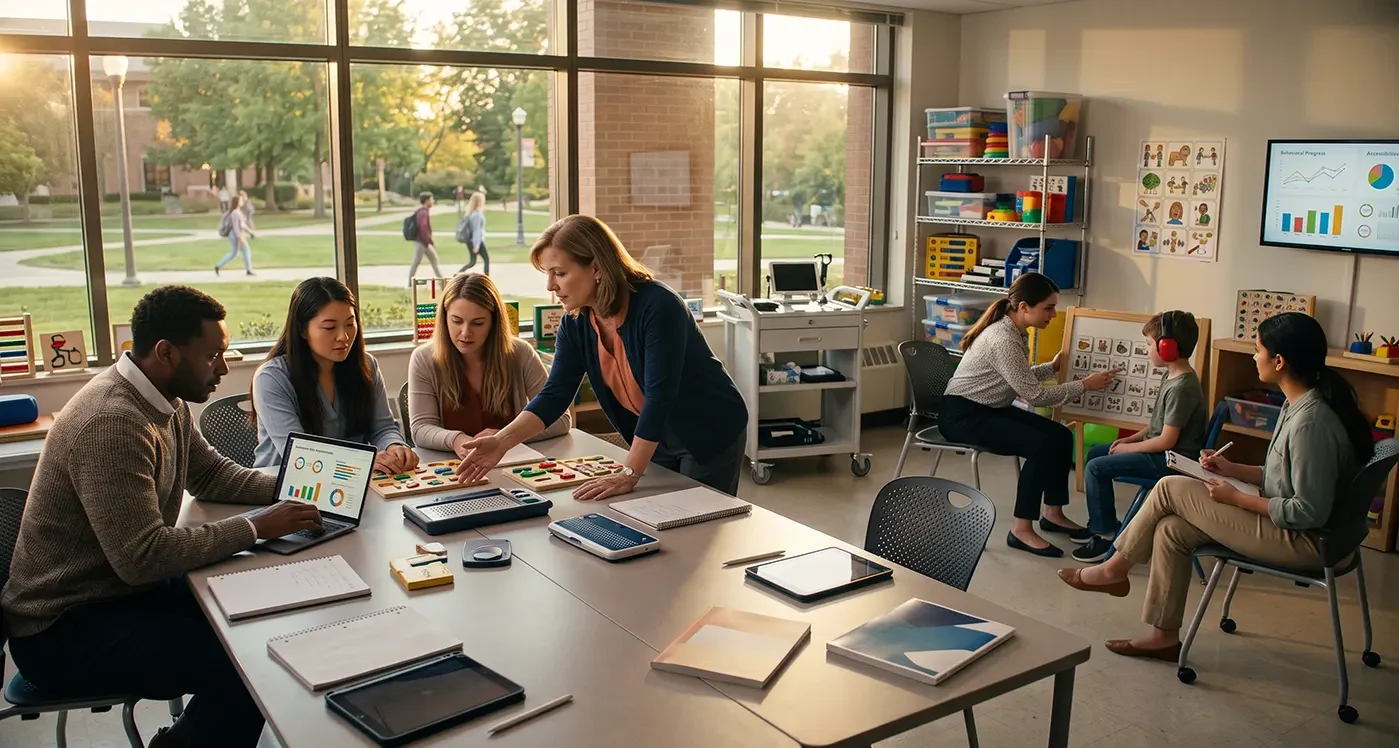

Inclusive PE Games that Promote SEL for Neurodivergent Students

Inclusive PE Games that Promote SEL for Neurodivergent Students

The core of an inclusive PE program is the “STEP” tool—adjusting Space, Task, Equipment, and People. When games are designed with these adjustments in mind, they move beyond physical fitness and begin to address CASEL’s core competencies: self-awareness, social awareness, and relationship skills.

1. Collaborative Balloon Polo

Unlike traditional hockey or soccer, Balloon Polo slows down the pace of play, reducing the “fight or flight” response often triggered by fast-moving objects.

  • The Game: Students use foam pool noodles to keep a balloon aloft and move it toward a wide goal (like a hula hoop).
  • SEL Impact: This game requires constant verbal and non-verbal communication. Students must regulate their physical force—hitting too hard sends the balloon out of reach—fostering self-management and impulse control.
  • Inclusive Tip: Use “jingling balloons” (balloons with a small bell inside) for students with visual impairments.

2. The “Mirroring” Movement Challenge

Neurodivergent students often struggle with …

Inclusive PE Games that Promote SEL for Neurodivergent Students Read More
Value of Microcredentials vs Traditional Degrees for Tech Careers in 2025

Value of Microcredentials vs Traditional Degrees for Tech Careers in 2025

The “Golden Ticket” of a four-year Computer Science degree is no longer the only way into Silicon Valley. As technological cycles—particularly in AI and Cybersecurity—now move faster than university curricula can be updated, the definition of a “qualified candidate” has shifted. In 2025, the most successful tech professionals are those who combine the foundational theory of a degree with the surgical precision of microcredentials.

The Case for Microcredentials: Speed and Agility

Microcredentials—short, competency-based certifications from providers like Google, NVIDIA, or AWS—have become the “currency” of the modern tech workforce.

  • Immediate ROI: Recent 2025 reports indicate that 90% of employers are now willing to offer higher starting salaries (often 10–15% more) to candidates with relevant microcredentials, especially in Generative AI.
  • Real-World Readiness: While a degree teaches you how a computer thinks, a microcredential proves you can use a specific tool (like Kubernetes or TensorFlow) to solve a business problem on
Value of Microcredentials vs Traditional Degrees for Tech Careers in 2025 Read More
How to Use Wearable Fitness Trackers for Personalized Student Assessments in PE

How to Use Wearable Fitness Trackers for Personalized Student Assessments in PE

The traditional PE assessment (timed mile run, push-up tests) often measures a single moment of performance, potentially demotivating students who struggle. By integrating wearable fitness trackers, PE teachers can now provide personalized feedback, track progress over time, and foster a lifelong love for activity by focusing on individual improvement rather than comparison.

1. Objective Data for Individual Baselines

Wearables eliminate subjectivity. Instead of observing a student’s activity level, you get real-time metrics:

  • Heart Rate Zones: Trackers like Fitbits or Garmins can monitor a student’s heart rate, allowing teachers to assess if a student is working in their target “aerobic” or “anaerobic” zones during an activity.
  • Steps & Active Minutes: Consistent data on daily steps and active minutes provides a baseline for each student, allowing teachers to set achievable, incremental goals.
  • Calories Burned (Estimated): While not perfectly precise, this metric offers a tangible representation of energy expenditure during a class.
How to Use Wearable Fitness Trackers for Personalized Student Assessments in PE Read More
How to Balance a Full-Time Job and a Part-Time Master’s Degree

How to Balance a Full-Time Job and a Part-Time Master’s Degree

The decision to pursue a master’s degree while working full-time is a high-stakes investment in your future self. However, the transition can be jarring. In 2025, the most successful students aren’t those who work the hardest, but those who utilize time-blocking, leveraged technology, and transparent communication to protect their mental energy.

1. The Power of “Micro-Studying”

Gone are the days of the 8-hour library marathon. For the working professional, time is found in the “cracks” of the day.

  • The Strategy: Utilize your commute (audiobooks/lectures), your lunch break (reading one research paper), or the 30 minutes before your household wakes up.
  • Why it works: Small, consistent actions reduce the “intimidation factor” of large assignments and keep your research top-of-mind without requiring a massive cognitive shift.

2. Implement the Eisenhower Matrix

When you are juggling a career and a degree, you cannot treat every task as a priority. You must …

How to Balance a Full-Time Job and a Part-Time Master’s Degree Read More
How to Use Generative AI for Personalized Learning Paths in K-12 Classrooms

How to Use Generative AI for Personalized Learning Paths in K-12 Classrooms

The traditional classroom often struggles with the “middle” problem: lessons are too fast for some and too slow for others. Generative AI solves this by decoupling the curriculum from a single delivery method. In a personalized learning path, the learning objectives remain the same for everyone, but the materials, pace, and support are uniquely tailored to each student.

1. Differentiated Content Creation

Generative AI can instantly rewrite complex texts to match a student’s specific reading level.

  • The Strategy: A teacher can take a single article on the Water Cycle and use an AI tool like MagicSchool or Eduaide to generate three versions: one for advanced readers, one for students at grade level, and one for English Language Learners (ELL) with simplified vocabulary and visual descriptions.

2. AI-Powered “Scaffolded” Tutoring

Rather than giving students the answers, generative AI acts as a Socratic tutor. Tools like Khanmigo (from Khan Academy) engage students …

How to Use Generative AI for Personalized Learning Paths in K-12 Classrooms Read More