
Modern education increasingly relies on interactive teaching methods to improve student engagement, motivation, and long-term knowledge retention. Traditional lectures and repetitive assignments remain useful, but students often benefit from learning experiences that encourage active participation and immediate feedback. Gamification introduces game-inspired elements into educational activities, making lessons more interactive, goal-oriented, and rewarding. Through educational games, digital reward structures, and interactive technology tools, teachers can encourage students to practice concepts, overcome challenges, and monitor their progress. When implemented thoughtfully, gamification can support deeper learning and help students remember information more effectively. The key is to use game mechanics to reinforce meaningful educational objectives rather than allowing competition or rewards to overshadow learning.
Educational Games That Strengthen Knowledge Retention
Educational games are among the most practical gamification techniques in modern education. They encourage students to apply knowledge, solve problems, and receive feedback while participating in enjoyable activities. Instead of passively listening to explanations, learners actively retrieve information and practice important skills.
For example, teachers can use mathematics challenges, vocabulary games, science quizzes, and historical simulations to reinforce classroom concepts. A language teacher might organize a vocabulary matching competition, while a science teacher could introduce a digital simulation that allows students to investigate ecosystems or chemical reactions.
These activities support retrieval practice, which involves recalling information from memory. Repeated retrieval, especially when spaced across multiple lessons, can strengthen long-term retention. Games can also make repetition feel less monotonous by introducing different questions, challenges, and levels of difficulty.
However, educational games should match students’ ages, abilities, and learning objectives. Activities that are too easy may become boring, while excessively difficult challenges can discourage participation. Teachers should provide helpful feedback, opportunities to retry questions, and explanations that clarify incorrect answers.
The goal is not simply to make learning entertaining. Effective educational games help students practice essential concepts and understand why their answers are correct.
Digital Reward Structures That Encourage Motivation
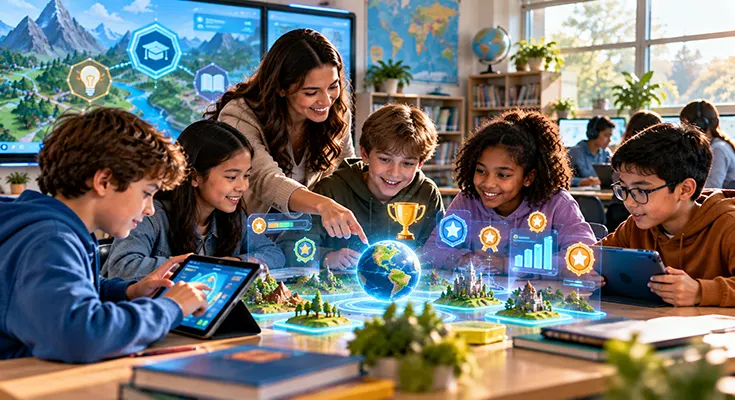
Digital rewards can provide visible recognition of student effort and progress. Common reward structures include points, badges, achievement levels, progress bars, virtual certificates, and milestone celebrations.
For instance, an online learning platform might award a badge when students complete a reading module, demonstrate mastery of a mathematical skill, or consistently submit assignments on time. Progress indicators can help learners recognize their achievements and understand which tasks remain unfinished.
Well-designed rewards emphasize meaningful progress rather than competition alone. Teachers can recognize improvement, persistence, collaboration, creativity, and mastery alongside high scores. This approach helps students with different abilities experience success and reduces the risk of discouraging learners who need more time.
Digital rewards should also be used carefully. Excessive reliance on points or prizes may encourage students to focus on earning rewards instead of understanding the material. Public leaderboards can create unnecessary pressure, especially when students have different starting points or learning needs.
A balanced system combines occasional recognition with informative feedback and opportunities for reflection. Students should gradually develop confidence, curiosity, and a sense of achievement that extends beyond external rewards.
Interactive Technology Tools for Gamified Learning
Interactive technology allows teachers to introduce gamification into both physical classrooms and online learning environments. Digital quiz platforms, learning management systems, educational applications, and virtual simulations can transform lessons into structured challenges with immediate feedback.
Teachers may use live quizzes to check understanding during a lesson or interactive exercises to reinforce previously learned material. Some platforms allow students to work individually, while others support team challenges and collaborative problem-solving.
Simulation-based learning is particularly useful for subjects that involve complex systems or practical decision-making. Students might manage a virtual business, explore a simulated environment, or conduct a digital science experiment. These activities allow learners to test ideas, examine consequences, and learn through experience without the risks or costs associated with certain real-world activities.
Technology also provides teachers with useful learning data. Quiz results and activity reports can reveal recurring mistakes, areas of difficulty, and concepts that require additional instruction.
Nevertheless, digital tools should complement effective teaching rather than replace it. Teachers need to evaluate the accuracy of educational content, protect student privacy, and ensure that students without reliable internet access or personal devices can participate through alternative activities.
Personalization and Progress-Based Challenges
One advantage of gamification is its ability to accommodate different learning speeds and levels of readiness. Progress-based challenges allow students to advance as they demonstrate understanding, while additional practice can support those who need more time.
For example, an online mathematics activity might begin with basic problems and gradually introduce more complex questions. Students who struggle can receive hints or review earlier examples, while advanced learners can attempt extension challenges.
Teachers can also organize learning into missions, stages, or themed units. Each stage should correspond to a clear educational objective, such as mastering multiplication, understanding grammar rules, or explaining a scientific process.
Personalization should not mean isolating students or labeling them according to ability. Instead, it should provide appropriate support and meaningful opportunities for growth. Collaborative missions can also encourage students to exchange ideas, help classmates, and develop communication skills.
Regular feedback remains essential. Students need to understand what they have mastered, what requires improvement, and which strategy might help them progress.
Measuring the Impact of Gamification on Learning
Although gamification can improve engagement, participation alone does not guarantee better learning outcomes. Teachers should evaluate whether game-based activities actually help students understand and retain information.
Useful approaches include short pre-assessments, post-activity quizzes, delayed recall tests, assignment reviews, and classroom observations. Comparing results over time can help teachers determine whether students remember concepts beyond the initial lesson.
Educators should also collect student feedback about the difficulty, accessibility, and usefulness of activities. If a game creates excitement but fails to reinforce the intended concept, its design may need revision.
Combining gamification with spaced repetition, retrieval practice, clear explanations, and constructive feedback can make learning more effective. Teachers should choose tools based on educational value, accessibility, and student needs rather than popularity alone.
Final Thought
Gamification techniques in modern education can support higher knowledge retention when educational games, digital rewards, and interactive technology are connected to clear learning objectives. These strategies encourage active participation, repeated practice, immediate feedback, and visible progress.
The most effective gamified learning environments balance enjoyment with academic purpose, recognize different forms of achievement, and provide opportunities for every student to improve. By evaluating learning outcomes and adjusting activities to meet student needs, educators can use gamification to create engaging lessons that support meaningful understanding and long-term retention.