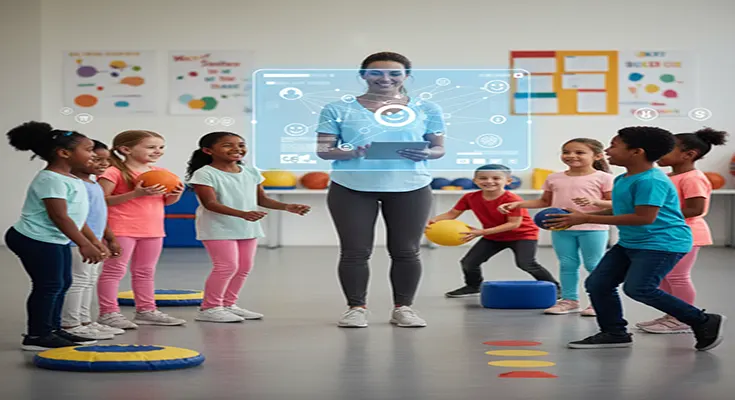
The core of an inclusive PE program is the “STEP” tool—adjusting Space, Task, Equipment, and People. When games are designed with these adjustments in mind, they move beyond physical fitness and begin to address CASEL’s core competencies: self-awareness, social awareness, and relationship skills.
1. Collaborative Balloon Polo
Unlike traditional hockey or soccer, Balloon Polo slows down the pace of play, reducing the “fight or flight” response often triggered by fast-moving objects.
- The Game: Students use foam pool noodles to keep a balloon aloft and move it toward a wide goal (like a hula hoop).
- SEL Impact: This game requires constant verbal and non-verbal communication. Students must regulate their physical force—hitting too hard sends the balloon out of reach—fostering self-management and impulse control.
- Inclusive Tip: Use “jingling balloons” (balloons with a small bell inside) for students with visual impairments.
2. The “Mirroring” Movement Challenge
Neurodivergent students often struggle with proprioception—the sense of where their body is in space.
- The Game: Students pair up. One student becomes the “leader,” performing slow, deliberate movements (like a “tree pose” or a slow-motion wave), while the partner mirrors them exactly.
- SEL Impact: This builds empathy and social awareness. To succeed, the leader must consider their partner’s ability, and the partner must focus intensely on another person’s cues.
- Inclusive Tip: Allow students to use “Choice Boards” to pick the movements, giving them autonomy and reducing performance anxiety.
3. Life-Sized “Social Journey” Board Game
Transform the gym floor into a giant board game using poly-spots or hula hoops.
- The Game: Students move through a path by rolling giant foam dice. Certain spots are “Team Challenges” where the whole group must complete a task (like standing in a circle and keeping a parachute level) to move forward.
- SEL Impact: This promotes relationship skills and collective problem-solving. Because the progress is tied to the group rather than the individual, it removes the “winner/loser” stigma that can lead to emotional dysregulation.
4. Sensory-Informed Obstacle Courses
Obstacle courses provide “heavy work” (proprioceptive input) which is naturally calming for many neurodivergent nervous systems.
- The Game: Create a circuit that includes “crashing” into soft mats, crawling through tunnels, and balancing on low beams.
- SEL Impact: Teachers can embed “Emotion Stations” where students must identify how they feel (using a visual emoji scale) before moving to the next task. This builds self-awareness by connecting physical exertion to emotional states.
Strategies for Success in 2025
To truly foster an inclusive environment, the physical space must be as intentional as the games themselves:
- The “Quiet Zone”: Always provide a designated, low-sensory area with weighted lap pads or noise-canceling headphones where a student can retreat if the gym becomes overwhelming.
- Visual Schedules: Use high-contrast visual timers and “First-Then” boards so students can predict transitions, which significantly reduces transition-based anxiety.
- Non-Competitive Scoring: Shift the focus from “points scored” to “goals reached together.” In 2025, many inclusive programs use “Cooperation Credits” to reward students for helping a peer or using a “calm down” strategy.
The Verdict
Inclusive PE is not about “dumbing down” sports; it is about widening the entrance. When we prioritize social-emotional learning, we ensure that neurodivergent students don’t just participate in PE—they thrive in it, carrying the lessons of regulation and teamwork far beyond the gym doors.