

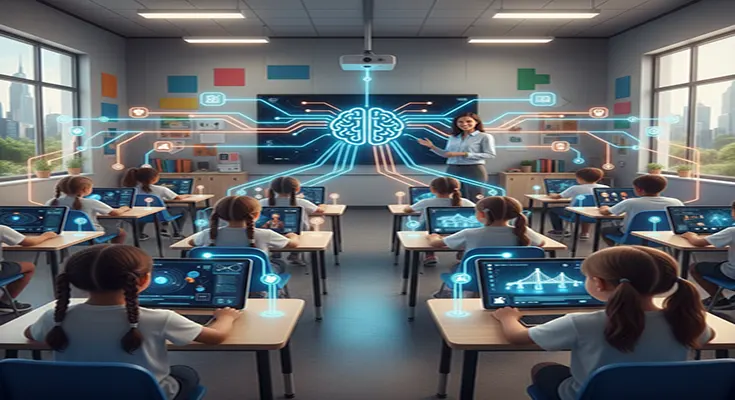
The traditional classroom often struggles with the “middle” problem: lessons are too fast for some and too slow for others. Generative AI solves this by decoupling the curriculum from a single delivery method. In a personalized learning path, the learning objectives remain the same for everyone, but the materials, pace, and support are uniquely tailored to each student.
1. Differentiated Content Creation
Generative AI can instantly rewrite complex texts to match a student’s specific reading level.
- The Strategy: A teacher can take a single article on the Water Cycle and use an AI tool like MagicSchool or Eduaide to generate three versions: one for advanced readers, one for students at grade level, and one for English Language Learners (ELL) with simplified vocabulary and visual descriptions.
2. AI-Powered “Scaffolded” Tutoring
Rather than giving students the answers, generative AI acts as a Socratic tutor. Tools like Khanmigo (from Khan Academy) engage students in a dialogue.
- How it works: If a student is struggling with a multi-step algebra problem, the AI doesn’t solve it for them. Instead, it asks, “What do you think the first step should be to isolate the variable?” This constant feedback loop ensures that students don’t get stuck and can progress at their own speed.
3. Interest-Based Learning Hooks
One of the most powerful ways to use generative AI is to align lessons with student interests. If a student is disengaged with history but loves Minecraft, a teacher can prompt an AI to “Explain the feudal system using Minecraft terminology and building concepts.” This level of extreme personalization was impossible before 2025 but is now achievable in seconds.
4. Real-Time Gap Identification
By integrating AI into a Learning Management System (LMS), educators can analyze performance data in real-time.
- The Path: If the AI detects that a student consistently misses questions related to “fractions,” it can automatically suggest a supplementary video or a 5-minute interactive simulation before the student moves on to “decimals.” This prevents small knowledge gaps from turning into permanent learning hurdles.
5. Multilingual and Accessibility Support
For diverse K-12 classrooms, AI provides instant translation and accessibility. A student whose primary language is Spanish can have their personalized path instructions translated instantly, or a student with visual impairments can have text converted into high-quality, descriptive audio.
Key Implementation Tips for Teachers
To ensure success, keep these “Human-in-the-loop” principles in mind:
- Prompt Engineering for Teachers: Learn to be specific. Instead of asking for “a lesson on plants,” ask for “a 3nd-grade level lesson on photosynthesis that includes a hands-on activity and a 3-question formative assessment.”
- Privacy First: Only use school-approved AI platforms that are compliant with FERPA and COPPA regulations to protect student data.
- Focus on Process, Not Output: Encourage students to use AI to brainstorm or outline, but require the final expression of knowledge to be their own.
The Verdict
Using generative AI for personalized learning paths isn’t about replacing the teacher; it’s about amplifying the teacher’s reach. It allows the educator to move away from the whiteboard and into the role of a mentor, spending more time on the social and emotional connections that no AI can replicate.